History
History
Every era in one timeline, with biographies and primary sources.
16 stories
-
Antiquity to today
Essay · Antiquity to today -
Antiquity to today
Note · Antiquity to today Persia or Iran? A short explainer
Both names are correct. They come from different directions, and Irooni uses each where it fits. 14 November 2026 -
c. 550–330 BCE
Essay · c. 550–330 BCE The Royal Road and how the Achaemenid empire was run
An empire stretching from Egypt to Central Asia needed roads, messengers and clerks. The evidence for all three is better than the legends. 14 November 2026 -
c. 539 BCE and after
Essay · c. 539 BCE and after Cyrus the Great and the Cylinder: what the evidence says
A small baked-clay object from Babylon has been called the first charter of human rights. Reading what it says, and what it does not, is a lesson in how history gets used. 14 November 2026 -
c. 520 BCE and after
Essay · c. 520 BCE and after Darius I and the Behistun inscription
On a cliff in western Iran, a king told the story of how he won the throne, in three languages. It is royal propaganda, and it is also the key that opened ancient writing. 14 November 2026 -
c. 518–330 BCE
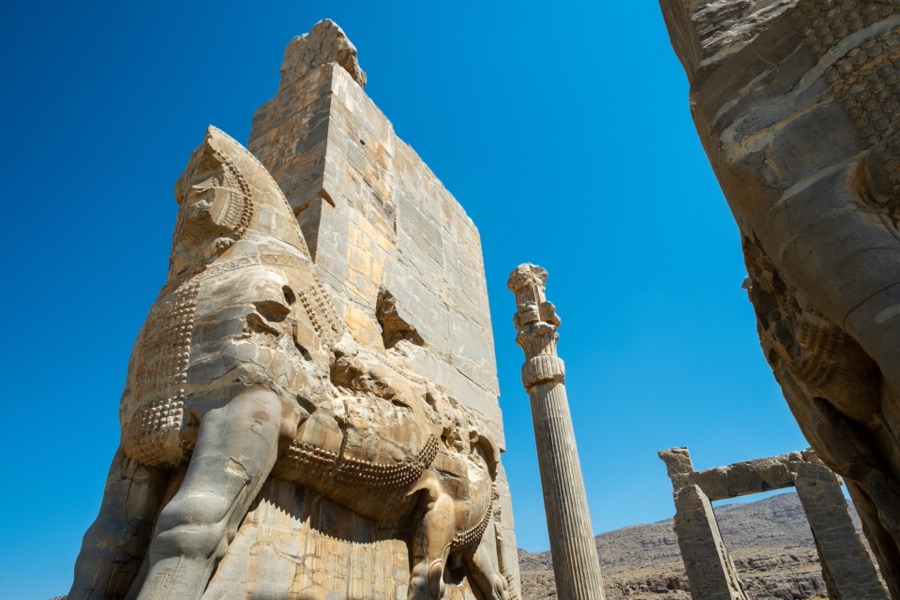 Feature · c. 518–330 BCE
Persepolis: a city built for ceremony
A vast terrace in the plain of Fars, begun under Darius I, was a stage for royal power. What it was for, and why it burned, is less certain than the guidebooks suggest. 14 November 2026 -
c. 247 BCE–224 CE
Essay · c. 247 BCE–224 CE The Parthians: Rome's other neighbour
For nearly five centuries a dynasty from north-eastern Iran ruled the lands between Rome and Central Asia. We know them mostly through their enemies. 14 November 2026 -
224–651 CE
Essay · 224–651 CE The Sasanians: an empire in stone and silver
From 224 to 651 CE the Sasanian kings ruled a state that rivalled Rome and Byzantium, and left rock reliefs that are still some of the best places to meet them. 14 November 2026 -
1921–1941
Essay · 1921–1941 Reza Shah and the making of the Pahlavi state, 1921–1941
A soldier took power in 1921, ended the Qajar dynasty in 1925 and spent sixteen years building a centralised state, with roads, railways and schools, and with little tolerance for opposition. 14 November 2026 -
1925–1979
Essay · 1925–1979 Women's lives in Iran, 1925–1979: laws, schools, workplaces and limits
Between 1925 and 1979 the law, schooling and work changed for many Iranian women. The changes were real, uneven and contested, and women themselves held very different views of them. 14 November 2026 -
1928–1941
Essay · 1928–1941 Hats, veils and the state: dress under Reza Shah
In the 1930s the state decided what Iranians should wear. For some it meant new freedoms, for many it meant coercion, and for the clergy and the devout it meant humiliation. 14 November 2026 -
1941–1949
Essay · 1941–1949 The 1940s: occupation, a new shah, new ideas
With the old shah gone and foreign troops in the country, Iran in the 1940s was a place of open politics, new parties and anxious questions about oil and independence. 14 November 2026 -
1951–1953
Essay · 1951–1953 Oil, Mossadegh and 1953: two readings of a coup
In August 1953 a government that had nationalised oil was overthrown. Historians agree that Britain and the United States took part. They disagree on how much it mattered. 14 November 2026 -
1953–1979
Essay · 1953–1979 Critical perspectives: censorship, SAVAK and the opposition
A picture of Iran before 1979 that leaves out repression is incomplete. So is one that leaves out everything else. This is the first in a standing series on what the state's critics said and what the records show. 14 November 2026 -
1960–1969
Essay · 1960–1969 The 1960s: the White Revolution and its limits
In 1963 the shah announced a programme of reforms from above, from land reform to votes for women. It changed the countryside and the cities, and it left deep disagreements. 14 November 2026 -
1970–1979
Essay · 1970–1979 The 1970s: oil boom, celebrations and unrest
A fourfold rise in oil income paid for grand plans and grand parties. It also produced inflation, inequality and a state with fewer and fewer ways to listen. 14 November 2026