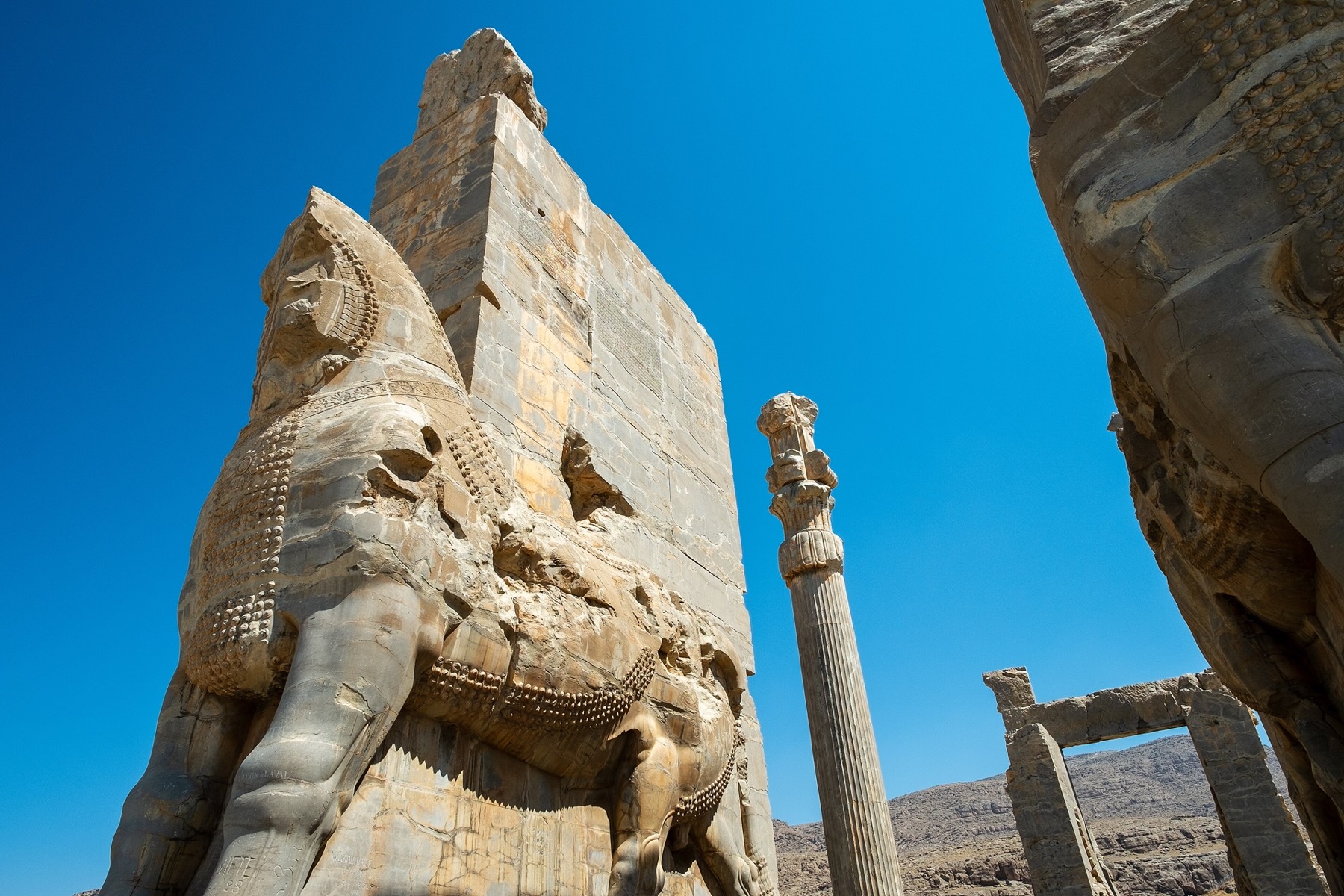
In brief. Persepolis was a ceremonial and administrative centre of the Achaemenid empire, the first Persian empire, which ruled from Egypt to Central Asia in the 6th to 4th centuries BCE. Much of what we know comes from its ruins, its reliefs and thousands of clay tablets.
Seen from the plain below, Persepolis is a raised platform of grey stone with a few tall columns still standing against the mountain. Its Old Persian name was Parsa. The Greek name, Persepolis, means “city of the Persians”, although it was never a city in the usual sense: it had palaces, halls, treasuries and storerooms, and the people who worked there lived around it.
A terrace for the king
The platform sits against the Kuh-e Rahmat, in the Marvdasht plain of Fars. Building began under Darius I, traditionally dated to about 518 BCE, and went on under his successors Xerxes and Artaxerxes I.
The start date of about 518 BCE rests on inscriptions and on the style of the early buildings, not on a foundation record. Treat it as a scholarly estimate.
The great audience hall, the Apadana, is the best-known building. Its stairways are covered in reliefs of rows of figures bringing gifts to the king, among them delegations in different dress. Xerxes added the Gate of All Nations, a gatehouse guarded by colossal bulls with human heads and wings. The style borrows from older Near Eastern palaces, which is typical of Achaemenid art: it gathered techniques and craftsmen from across the empire.
What was it for?
The honest answer is that scholars disagree. Persepolis was clearly a place of royal display and probably of receptions and ceremony. It also held treasuries and archives, so it was an administrative site too.
A popular idea is that the reliefs show the New Year festival, [[nowruz]], celebrated at Persepolis. There is no ancient text that says so, and many specialists doubt it. The figures can equally be read as envoys at a royal audience.
The reliefs are also read in different ways. Some call the procession “tribute”; others point out that the objects are presented as gifts and that the king’s authority is shown through order and harmony rather than through force. Root’s study of royal imagery is the standard place to start.
The people behind it
The most direct evidence of daily life comes from thousands of clay tablets in Elamite, found in a fortification wall in the 1930s. They are administrative records, mostly of rations issued to workers and travellers. They show a large and organised workforce that included skilled craftsmen, women and children, paid in food rather than coins.
The Fortification tablets record rations of grain, wine and livestock for workers and travellers in the region, and the amounts depend on the kind of work and the person’s rank.
Fire and rediscovery
In 330 BCE Alexander of Macedon took the Persian heartland, and the palace complex burned. Greek and Roman writers describe the burning and give different reasons, from revenge for the Persian destruction of Athens to a drunken impulse. Burnt layers in the ruins confirm that a major fire happened. Why it happened is not settled.
Ancient authors wrote centuries after the event, and their stories differ. Modern historians debate whether the fire was deliberate policy or an accident that was later given a motive.
The ruins were visited and drawn by European travellers for centuries before large-scale excavation began in the 1930s. Excavation was carried out by the University of Chicago’s Oriental Institute, first under Ernst Herzfeld and then under Erich Schmidt. UNESCO inscribed Persepolis on the World Heritage list in 1979. That story, including who owns the finds and where they should be kept, is for another article.
Notes and sources
- Erich F. Schmidt, Persepolis I–III (University of Chicago Oriental Institute Publications 68, 69, 70; 1953–1970).
- Margaret Cool Root, The King and Kingship in Achaemenid Art (Brill, Acta Iranica 19, 1979).
- Pierre Briant, From Cyrus to Alexander: A History of the Persian Empire, trans. Peter T. Daniels (Eisenbrauns, 2002).
- Richard T. Hallock, Persepolis Fortification Tablets (Oriental Institute Publications 92, 1969).
- John Curtis and St John Simpson (eds), The World of Achaemenid Persia (I.B. Tauris, 2010).
- Amélie Kuhrt, The Persian Empire: A Corpus of Sources from the Achaemenid Period (Routledge, 2007).
Image credits
- Skot, CC BY-SA 4.0, Source

This article is also available in: Nederlands فارسی