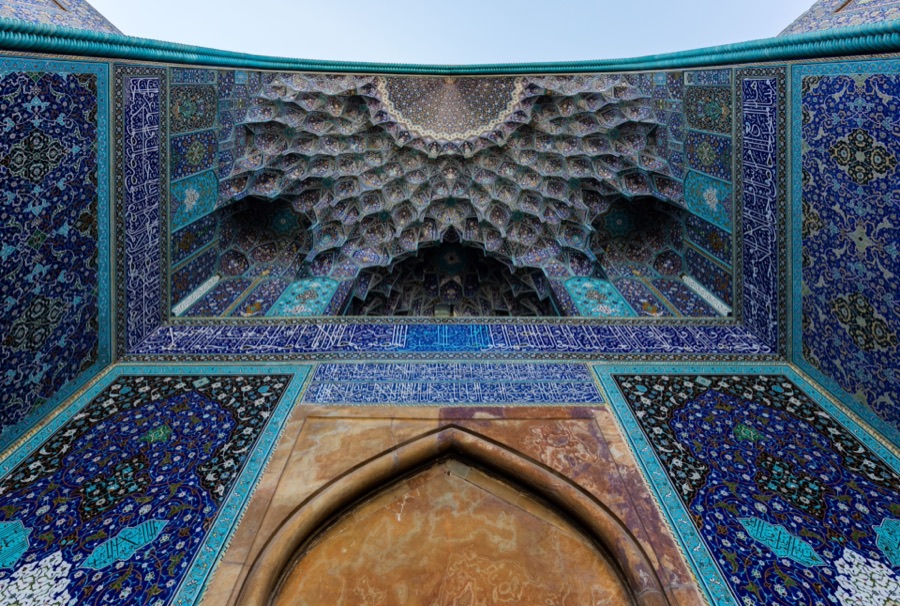
Walk into the main entrance of an old Iranian bazaar and the city changes. The street becomes a covered passage, noise and light drop, and rows of small shops open on both sides. The Persian bazaar is both a market and a piece of urban design.
How it is built
The classic bazaar is a network of vaulted or domed passages, called rasteh, each often devoted to one trade: copper, gold, carpets, spices, shoes. The roofs have small openings that let in light and air, and thick brick walls keep out heat. Wider domed halls, timcheh, form crossings where several passages meet. Behind the shops are sara or caravanserais: courtyards surrounded by storerooms and rooms where merchants stayed and did business.
More than a market
The bazaar sits at the centre of the old city and is joined to its main institutions. Mosques, baths, schools and teahouses often lie within or next to it, and the largest ones were built or supported by rulers and merchants alike. In Isfahan, the royal gateway on the square leads straight into the covered market, linking the court, the congregation and commerce.
Historians describe the bazaar as the economic and social spine of the traditional Iranian city. Its guilds, its charitable foundations and its networks of credit gave merchants a strong role in city life.
Great bazaars
The bazaar of Tabriz, a huge network of brick halls and passages, is a UNESCO World Heritage site. Isfahan, Kerman, Shiraz and Yazd have older complexes with their own character, among them the Vakil Bazaar in Shiraz and the Ganjali Khan complex in Kerman.
Today
Traditional bazaars face competition from shopping centres and online trade, and many also face problems of upkeep, but they remain busy. They are a good place to see crafts at work: metal beaten into trays, textiles block-printed, nuts and dried fruit weighed out, tea poured while you bargain.
Bargaining and personal relationships are still an important part of trade in the traditional bazaar. A shopkeeper often offers tea before any price is discussed.
Notes and sources
- Stephen P. Blake, Half the World: The Social Architecture of Safavid Isfahan, 1590–1722 (Mazda, 1999).
- UNESCO World Heritage Centre, 'Tabriz Historic Bazaar Complex' (listing text; cite the exact page when checked).
- Encyclopaedia Iranica, entry 'Bazaar' (iranicaonline.org). Exact entry title and author to be added after the entry is opened.
This article is also available in: Nederlands فارسی