Persian is written from right to left, in a script that was adopted from Arabic after the 7th century and adapted to Persian by adding letters for sounds that Arabic does not have: p, ch, zh and g. Most letters join to the next one, so a word is a single flowing shape. Short vowels are usually not written, and readers fill them in.
Hands and styles
Calligraphers speak of different “hands”. Naskh is clear and regular, and it is often used for copying texts. Thuluth has large, curving shapes and is used for titles and inscriptions on buildings. Nastaliq is the typical hand for Persian poetry.
Nastaliq took shape in Iran in the 14th and 15th centuries and is often described as combining two older scripts. Tradition gives credit to the calligrapher Mir Ali Tabrizi, but the details of its development are not fully known.
How to look at a nastaliq page
Nastaliq runs along a sloping line, with long horizontal strokes, short vertical ones and rounded bowls. The words seem to settle into the page. In a poem, each line is usually written as two halves, one above the other, in columns, with decorated borders. Dots matter: they tell similar letter shapes apart, and calligraphers place them with rhythm.
You do not need to read the language to see the qualities calligraphers admire: even spacing, a steady line and a balance of thick and thin strokes.
Tools
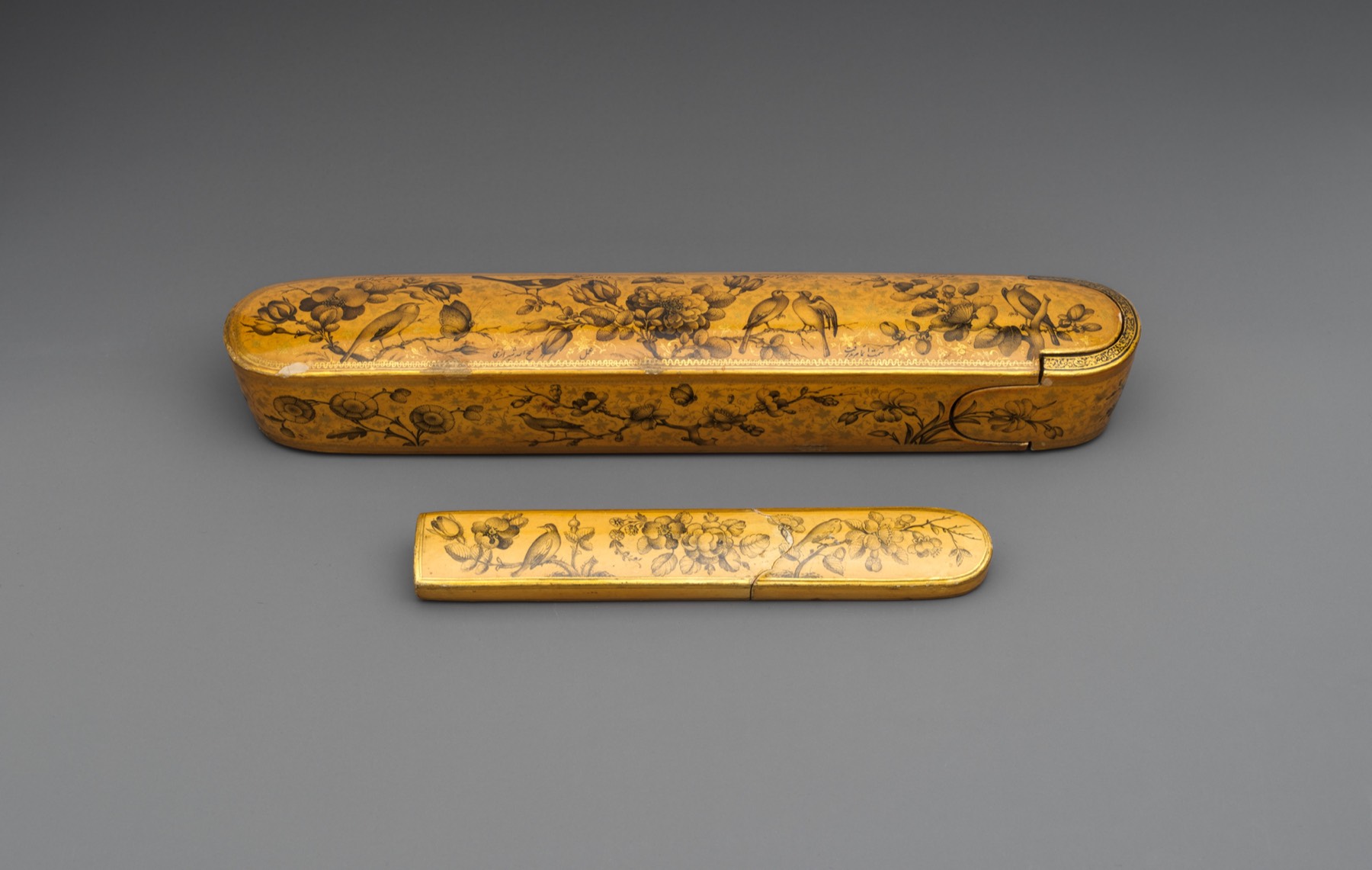
The pen, the qalam, is cut from reed or bamboo. Its tip is cut at an angle, and it is dipped in ink and used on paper polished with starch. The pen box in our picture, a lacquered case from the 19th century, is a reminder that the pen was a prized object, kept with its ink and knife.
Beyond the book
Calligraphy appears on tiles, mosque walls, coins, metalwork and everyday objects, and today in posters and logos. Learning to notice it makes a visit to a museum or a mosque in Iran richer.
Notes and sources
- Encyclopaedia Iranica, entry 'Calligraphy' (iranicaonline.org). Exact entry title and author to be added after the entry is opened.
- The Metropolitan Museum of Art, catalogue record for the pen box and case shown (cite the accession number from the museum record).
Image credits

This article is also available in: Nederlands فارسی